
Expertise
Laboratory Automation
Automation only delivers when software, instruments, data and process move together. That integration is where UVJ is strongest.
Overview
What it is
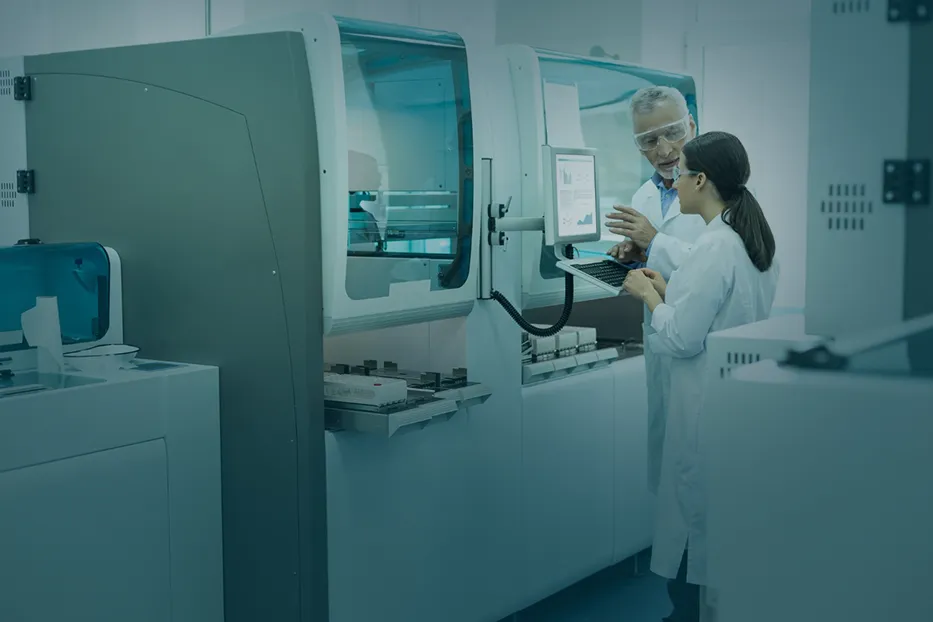
Laboratory automation uses robotics, instrument control and software to perform laboratory work with minimal human intervention. Real automation is not one machine replacing one pair of hands; it is an orchestrated system in which instruments, liquid handling, image processing, data capture and reporting operate as a connected workflow. The software layer is what makes that system coherent.
The problem
Problems we solve
- Manual, repetitive steps that consume skilled scientist time
- Throughput limited by handoffs between instruments and people
- Sample and result data that cannot be traced end to end
- Instruments with proprietary interfaces that resist integration
- Assays that are difficult to reproduce consistently
Capabilities
What we build
Laboratory device automation and orchestration software
Liquid handling and microfluidics control
Digital image processing and automated analysis
Instrument adapters and LIMS/ELN integration
Firmware for laboratory instruments
Automated clinical analysis and diagnostic workflows
Toolkit
Technologies & capabilities
- Instrument and device communication protocols
- Embedded firmware and real-time control
- Computer vision and digital image processing
- Workflow orchestration and scheduling
- Cloud and edge data pipelines
- AI and machine learning for adaptive optimisation
Who it is for
Designed for
- Pharmaceutical and biotechnology R&D laboratories
- Clinical and diagnostics laboratories
- Genomics and screening facilities
- Instrument manufacturers building automation into products
Why UVJ
Why teams choose UVJ for this
End-to-end, not one instrument
We automate the workflow, not just a device, connecting instruments, data and process into a single system.
Firmware and application together
We work at both the device level and the platform level, which is where the hardest integration problems live.
Validated for regulated labs
Systems are built to satisfy the audit, traceability and safety requirements of regulated laboratory environments.
Domains
Where this expertise applies
Laboratory Device Automation
Integration of instruments, software and workflows so laboratory tasks run with minimal human intervention.
Lab Software & Methodologies
Algorithms and methodologies that automate processes, manage data and improve experimental precision.
Automated Clinical Analysis
Robotics and software that streamline clinical testing, analysis and diagnosis at high throughput.
Firmware & Embedded Control
Real-time firmware for instruments, with OTA update and safety-compliance support.
Digital Image Processing
Computer vision and deep learning for microscopy, plate reading and cellular classification.
Instrument Adapters
Adapters and APIs connecting instruments to LIMS, automation platforms and data systems.
In focus
Specialist areas
Liquid handling
Automated dispensing, mixing, transfer and management of liquids, with precision control and integration into larger workflows.
Microfluidics
Control software for the manipulation of fluids at microscopic scale within micro-channel systems.
Radiometry
Precise measurement of radiation and radioactive materials for diagnostics and drug development applications.
High-throughput screening
Robotic liquid handling, automated plate reading and intelligent software to screen compounds at scale with consistency.
Genotyping, microarrays & proteomics
Automated genetic analysis, expression profiling and protein characterisation pipelines.
Assay development
Software support for assay design, execution, validation and result processing.
FAQ
Frequently asked questions
What lab automation services does UVJ provide?
End-to-end software across three pillars — laboratory device automation, lab software algorithms and methodologies, and automated clinical analysis and diagnosis — spanning liquid handling, image processing, microfluidics, instrument adapters, firmware and clinical diagnostics.
How does UVJ integrate with LIMS and ELN systems?
With bidirectional integration that enables automated sample tracking, real-time data exchange, result validation, workflow scheduling and full audit trails, connecting instruments, data and processes into one ecosystem.
What is the role of firmware in laboratory automation?
Firmware is the low-level software embedded in instruments — robotic arms, pipetting systems, centrifuges and sensors — that controls hardware in real time and bridges device behaviour to higher-level platforms such as LIMS and SCADA.
How does AI enhance lab automation?
AI enables predictive analytics, workflow optimisation, anomaly detection and adaptive experiment planning. We integrate AI-driven optimisation into liquid handling, digital image processing, clinical diagnostics and genotyping workflows.
How does digital image processing help in healthcare and pharma?
It automates image enhancement, analysis and interpretation from microscopes, plate readers and spectrophotometers — supporting histopathology analysis, cellular classification, compound screening and morphology analysis. Our capabilities include AI-powered object detection, deep learning segmentation and automated QC reporting.
Related solutions
Life Sciences
Two decades of software and engineering for scientific organisations — from instruments and laboratory workflow to bioinformatics, cheminformatics and regulated data.
Learn moreScientific Software
Custom software for instruments, scientific workflows and regulated research environments — built to be validated, auditable and maintainable for years.
Learn moreBioinformatics
Pipeline engineering, analysis tooling and scalable data platforms for genomic, transcriptomic and multi-omic research.
Learn moreLet's engineer what's next.
Tell us about the problem. You will speak with an engineer who understands the domain, not a call centre.